Es cierto, Auden: la naturaleza estaba tan cerca,
los patos cortaban las calles,
y las ardillas buscaban el sol
conociendo mejor que nadie el frío …………….de tus mañanas.
Aquí llegamos luego de la Escocia Salvaje,
con el acento de martillo que cortaba la leña.
Aunque encontramos la paz de tu álbum, ……..……..pequeño Londres encantado,
tu elegía a la tierra nacía desde norte de Yorkshire.
Aquí podríamos haber estudiado, nunca trabajado.
Porque afuera están las tiendas, la totalidad de un país ……..……..infortunio, infortunio, etc.
Entre el castillo Clifford y el Ouse,
la ciudad y el campo, para siempre estancados.
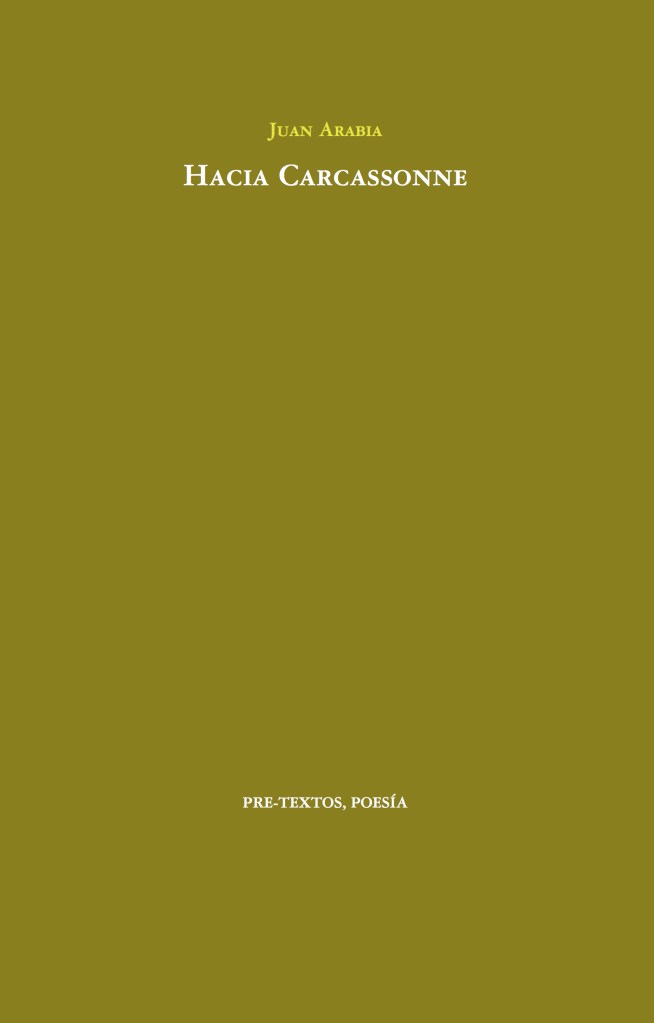
“Hacia Carcassonne”, de Juan Arabia, editorial Pre-Textos (Valencia, 2021).
–
–
Purgatorio Crane
Exile is thus a purgatory
Toma este mar cuyo diapasón toca las campanas de oraciones en papiros de plata nevada.
El exilio es así un purgatorio, donde Dante se amarra.
Átennos entonces al tiempo, con estaciones claras, Déja s´agitent! junto a los trovadores de las barcas.
No nos arrimemos a orilla alguna, ……………………………………dijo el jefe, hasta que la amplia mirada del paraíso sea correspondida con el vórtice de nuestras almas.
La naturaleza está tan cerca: los cuervos en el jardín de la universidad como ágiles niños que aún hablan el lenguaje del sentimiento; junto a la torre, el río todavía corre y correrá hacia al mar, ………………..y las piedras en esa torre aún están ………………..completamente satisfechas con su peso.
Y los minerales y las criaturas, tan profundamente enamorados de sus vidas que su pecado de acedia excluye a todos los demás, desafían a los estudiantes nerviosos con una belleza descuidada, ………………..estableciendo un solo error ………………..contra sus innumerables faltas.
Oh, en estos cuadriláteros donde la Sabiduría se honra a sí misma ¿La piedra original simplemente hace eco de esa alabanza? De forma superficial, o bien pronuncie un suave himno de consuelo, ………………..¿La equívoca bendición del fundador ………………..sobre todos los que persiguen el éxito?
Prometiendo a la espada afilada todos los premios resplandecientes, los autos, los hoteles, el servicio, la cama bulliciosa, posteriormente poder, para silenciar el ultraje con un testamento, ………………..las lágrimas de la viuda olvidadas, ………………..los huérfanos nunca escuchados.
Susurrando a los choferes y a las pequeñas niñas, a los turistas y señores, ese Conocimiento se concibe en el útero caliente de la Violencia quien en una hora tardía de aprensión y cansancio ………………..empuja hacia su pecho lloroso ………………..esa querida cabeza de ojos azules.
¿Y es ese niño feliz con su caja de libros de la suerte y todas las bromas del aprendizaje? Los pájaros no pueden llorar: la sabiduría es un pájaro hermoso; pero al sabio ………………..a menudo se le niega ………………..ser bueno o hermoso.
Afuera están las tiendas, la totalidad, todo el verde país donde un cigarrillo consuela a los malvados y un beso a los débiles; hay miles de personas que se mueven inquietas y gastan su dinero: ………………..Eros Paidagogos ………………..llora en su lecho virginal.
¡Ah, si ese mundo irreflexivo, casi natural, arrebatara su dolor a su amoroso corazón sensual! Pero él es Eros y debe odiar lo que más ama; ………………..y ella es de la Naturaleza; la Naturaleza ………………..sólo puede amarse a sí misma.
Y sobre la ciudad habladora, como cualquier otra, lloran los indiferentes ángeles. Aquí también el conocimientos de la muerte es un amor ardiente: y el corazón natural rechaza ………………..la voz baja y poco favorecedora ………………..que no descansa hasta que encuentra una audiencia.
–
Oxford
Nature is so near: the rooks in the college garden Like agile babies still speak the language of feeling; By the tower the river still runs to the sea and will run, ………………..And the stones in that tower are utterly ………………..Satisfied still with their weight.
And the minerals and creatures, so deeply in love with their lives Their sin of accidie excludes all others, Challenge the nervous students with a careless beauty, ………………..Setting a single error ………………..Against their countless faults.
O in these quadrangles where Wisdom honours herself Does the original stone merely echo that praise Shallowly, or utter a bland hymn of comfort, ………………..The founder’s equivocal blessing ………………..On all who worship Success?
Promising to the sharp sword all the glittering prizes, The cars, the hotels, the service, the boisterous bed, Then power to silence outrage with a testament, ………………..The widow’s tears forgotten, ………………..The fatherless unheard.
Whispering to chauffeurs and little girls, to tourists and dons, That Knowledge is conceived in the hot womb of Violence Who in a late hour of apprehension and exhaustion ………………..Strains to her weeping breast ………………..That blue-eyed darling head.
And is that child happy with his box of lucky books And all the jokes of learning? Birds cannot grieve: Wisdom is a beautiful bird; but to the wise ………………..Often, often is it denied ………………..To be beautiful or good.
Without are the shops, the works, the whole green country Where a cigarette comforts the guily and a kiss the weak; There thousands fidget and poke and spend their money: ………………..Eros Paidagogos ………………..Weeps on his virginal bed.
Ah, if that thoughtless almost natural world Would snatch his sorrow to her loving sensual heart! But he is Eros and must hate what most he loves; ………………..And she is of Nature; Nature ………………..Can only love herself.
And over the talkative city like any other Weep the non-attached angels. Here too the knowledge of death Is a consuming love: And the natural heart refuses ………………..The low unflattering voice ………………..That rests not till it find a hearing.
–
–
Thirties Poets: W. H. Auden | Louis MacNeice | Cecil Day-Lewis | Stephen Spender | Selección y Traducción de Juan Arabia & Rodrigo Arriagada Zubieta | Buenos Aires Poetry, Buenos Aires, Mayo, 2021 | 316 p. | Diseño de Portada: Camila Evia
Extraído de Selected poems, by MacNeice, Louis, 1907-1963; Longley, Michael, Publication date 1990, pp. 34-36 | Publisher Winston-Salem, N.C. : Wake Forest University Press | Traducción de Juan Arabia | Imagen: Louis MacNeice at Oxford University. Photograph: Writer Pictures
–
–
Posdata a Islandia
para W. H. Auden
Ahora que comienzan las noches de invierno el consuelo solitario me encierra; así que antes que la memoria se equivoque repaso nuestro viaje a Islandia –
Ni idílico ni romántico para mí en una mítica orilla sino un giro fantástico, ya sabes, intercalado en un espectáculo más serio.
Abajo en Europa cayó Sevilla, naciones germinando el infierno, los juegos olímpicos se llevaron a cabo – manchas sobre el sol ario.
Y el don expuso en mí cómo el paisaje del norte había inferido el estilo de la saga avanzando lentamente milla por milla.
Y el don replicó en ti que el Norte empieza por dentro, nuestras entrañas ascéticas requieren aires del fuego latino.
A pesar de todo, sin cercar un solo fantasma, éramos felices mientras observábamos cuervos desde sus muros de pizarra cruzar alrededor de la ballena podrida,
mientras observábamos hervir las cuencas de azufre, bucles de vapor enrollándose y desenrollándose, mientras el valle se desvanecía en un boceto del Día del Juicio Final.
Así anduvimos, bromeando y fumando sin milagros evocados, sin levitaciones ganadas en el tenue sol irreal;
en esta isla nunca se vieron florecer visiones desde el suelo, ni conversiones como la de San Pablo, ningún gran acontecimiento en absoluto.
Las vacaciones deberían ser así, libres de énfasis excesivo, es hora de que el alma se estire un poco y escupa antes de que el mundo vuelva sobre sí,
antes de que las chimeneas en interminables hileras se burlen en el humo, “Te lo dijimos” y las sirenas envueltas en niebla invoquen la ruina del largo malecón.
Filas de libros a mi alrededor están de pie, cercándome a cada lado; a través de ese bosque de palabras muertas cazaría a los pájaros vivos –
grandes pájaros negros que vuelan solos lentamente a través de una tierra de piedra, y las gaviotas que tejen un libre manto de ritmo sobre el mar.
Aquí en Hampstead me siento hasta altas horas de la noche que nadie comparte y espero que suene el teléfono o ángeles desconocidos en la puerta;
mejor eran los cielos del norte que este desierto disfrazado – alfombras y almohadones y el largo espejo que repite la canción.
Por la letanía de la duda de estas paredes sale el aliento hasta que la habitación se convierte en un pozo tarareando de miedo
con miedo a la soledad y a la falta de comunicación; todos los cables están cortados, amigos míos, viven más allá de los extremos cortados.
Así que escribo estas líneas para ti que también has sentido el deseo de morir, pero tu codicia por la vida prevalece – bebiendo café, contando historias.
Nuestras prerrogativas como hombres se cancelarán quién sabe cuándo, todavía bebo a tu salud antes que la culata golpee la puerta.
–
Postcript to Iceland
for W. H. Auden
Now the winter nights begin Lonely comfort walls me in; So before the memory slip I review our Iceland trip –
Not for me romantic nor Idyll on a mythic shore But a fancy turn, you know, Sandwiched in a graver show.
Down in Europe Seville fell, Nations germinating hell, The Olympic games were run – Spots upon the Aryan sun.
And the don in me set forth How the landscape of the north Had educed the saga style Plooding forward mile by mile.
And the don in you replied That the North begins inside, Our ascetic guts require Breathers from the Latin fire.
So although no ghost was scotched We were happy while we watched Ravens from their walls of shale Cruise around the rotting whale,
Watched the sulphur basins boil, Loops of steam uncoil and coil, While the valley fades away To a sketch of Judgment Day.
So we rode and joked and smoked With no miracles evoked, With no levitations won In the thin unreal sun;
In that island never found Visions blossom from the ground, No conversions like St Paul, No great happenings at all.
Holidays should be like this, Free from over-emphasis, Time for soul to stretch and spit, Before the world comes back on it,
Before the chimneys row on row Sneer in smoke,“We told you so” And the fog-bound sirens call Ruin to the long sea-wall.
Rows of books around me stand, Fence me round on either hand; Through that forest of dead words I would hunt the living birds –
Great black birds that fly alone Slowly through a land of stone, And the gulls who weave a free Quilt of rhythm on the sea.
Here in Hampstead I sit late Nights wich no one shares and wait For the phone to ring or for Unknown angels at the door;
Better were the northern skies Than this desert in disguise – Rugs and cushions and the long Mirror which repeats the song.
For the litany of doubt From these walls comes breathing out Till the room becomes a pit Humming with the fear of it
With the fear of loneliness And uncommunicableness; All the wires are cut, my friends Live beyond the severed ends.
So I write this lines for you Who have felt the death-wish too, But your lust for life prevails – Drinking coffee, telling tales.
Our prerogatives as men Will be cancelled who knows when; Still I drink your healt before The gun-butt raps upon the door.
–
–
Thirties Poets: W. H. Auden | Louis MacNeice | Cecil Day-Lewis | Stephen Spender | Selección y Traducción de Juan Arabia & Rodrigo Arriagada Zubieta | Buenos Aires Poetry, Buenos Aires, Mayo, 2021 | 316 p. | Diseño de Portada: Camila Evia
–
Louis MacNeice nació el 12 de septiembre de 1907 en Belfast, Irlanda. Asistió a Oxford, donde se especializó en clásicos y filosofía. En 1930, se casó con Giovanna Ezra y aceptó un puesto como profesor de clásicos en la Universidad de Birmingham, cargo que ocupó hasta 1936, cuando pasó a enseñar griego en Bedford College for Women, Universidad de Londres. En 1941, MacNeice se unió a la British Broadcasting Company como escritor y productor. Como muchos poetas ingleses modernos, MacNeice encontró audiencia para su trabajo a través de la radio británica. Algunas de sus obras más conocidas, incluidas Christopher Columbus (1944) y The Dark Tower (1946), fueron escritas originalmente para la radio y publicadas posteriormente. Al principio de su carrera, MacNeice se identificó con un grupo de poetas políticamente comprometidos cuyo trabajo apareció en la antología New Signatures de Michael Roberts. A pesar de su asociación con los jóvenes poetas británicos (conocidos como “Auden Group” y “Thirties Poets”) Stephen Spender, W. H. Auden, Cecil Day-Lewis y otros poetas de izquierda, MacNeice desconfiaba tanto de los programas políticos como de los sistemas filosóficos. Nunca fue miembro del Partido Comunista ni de ningún otro grupo político, y fue bastante sincero sobre las ambigüedades de sus actitudes políticas. “Mis simpatías son de izquierda”, escribió, “pero no en mi corazón ni en mis entrañas”. Aunque eligió vivir la mayor parte de su vida en Londres, MacNeice regresaba con frecuencia a los paisajes de su infancia y se enorgullecía de su herencia irlandesa. De principio a fin, su propia obra refleja un escepticismo melancólico demasiado honesto para dar el asentimiento final a cualquier tipo de sistema. Murió a los 55 años el 3 de septiembre de 1963, a causa de neumonía, poco antes de la publicación de su último libro de poemas, The Burning Perch.
Se llamóThirties (también War Generation) a un conjunto de poetas ingleses de la década del 30 (W. H. Auden, Louis MacNeice, Cecil Day-Lewis, Stephen Spender, entre otros), que asumió un rol activo frente a la contingencia de una sociedad en crisis, con variables colectivas dramáticas y urgentes. Este grupo era, por un lado, epígono de la Primera Guerra Mundial, con su rémora de cerca de diez millones de muertos; por el otro, antesala de la Segunda, con sus siguientes millones de vidas por cobrar. “Los Thirties”: autores que hicieron propaganda de una poesía al servicio del socialismo [¡La burguesía tiene que esperar un poco de dolor, una penitencia!]. A. T. Tolley, en THE POETRY OF THE THIRTIES, sencillamente decía hacia 1975: “Un cambio que está asociado en los nuevos poetas de los años treinta: la aparición de una preocupación por temas políticos”.
En Memoria de W. B. Yeats trad. Juan Arabia Él desapareció en pleno invierno: Los arroyos estaban helados, los aeropuertos casi desiertos, Y la nieve desfiguró las estatuas públicas; El mercurio se hundió en la boca del agonizante día. Los instrumentos con que contamos coinciden, El día de su muerte fue un día oscuro y frío. Lejos de su enfermedad Los lobos corrieron por los bosques siempre verdes, El río pueblerino no se dejaba tentar por los muelles de moda; Por el luto de las lenguas Sus poemas se mantuvieron a salvo de la muerte del poeta. Pero para él fue su última tarde como sí mismo, Una tarde de enfermeras y rumores; Las provincias de su cuerpo se revelaron, Los cuadrados de su mente quedaron vacíos, En silencio invadió los suburbios, La corriente de su sentimiento falló: se convirtió en sus admiradores. Ahora está esparcido entre cien ciudades Y entregado por completo a los afectos desconocidos; Para encontrar su felicidad en otra clase de madera Y ser castigado bajo un código de conciencia extranjero. Las palabras de un muerto Se modifican en las entrañas de los vivos. Pero en la importancia y en el estruendo del mañana Cuando los corredores rujan como bestias en el piso de la Bolsa, Y los pobres tengan los mismos sufrimientos a los que están acostumbrados, Y cada uno en su celda esté casi convencido de su libertad, Algunos miles pensarán en este día Como uno piensa en un día en el que hizo algo inusual. Los instrumentos con que contamos coinciden, El día de su muerte fue un día oscuro y frío.
–
En la década de 1930, Gran Bretaña se encontraba en un período de crisis social, con las secuelas de la Gran Guerra aún sintiéndose y otra guerra mundial parecía probable. Las clases trabajadoras estaban insatisfechas con lo que veían como una sociedad burguesa gobernante y una serie de reformas sociales fallidas. Esta época de crisis trajo consigo una nueva tendencia para las identidades colectivas, y el Grupo Auden, predominantemente una herramienta periodística (evidente desde 1936), fue una de ellas. Conocido además como Thirties Poets, el grupo que se centró en Auden representó un estilo literario nuevo y más experimental. El Grupo Auden, de hecho, nunca trabajó en conjunto, y estaban conectados principalmente por edades similares, educación de Oxbridge, inclinaciones socialistas, sentimientos sociales y vergüenza por sus propios orígenes de clase media.
–
“NEVER YIELD BEFORE THE BARREN”. D. H. LAWRENCE
Thirties Poets: W. H. Auden | Louis MacNeice | Cecil Day-Lewis | Stephen Spender | Selección y Traducción de Juan Arabia & Rodrigo Arriagada Zubieta | Buenos Aires Poetry, Buenos Aires, Mayo, 2021 | 316 p. | Diseño de Portada: Camila Evia
La naturaleza es un templo donde pilares vivientes
dejan a veces salir palabras confusas.
Hombres y mujeres pasan por los bosques de símbolos
que los observan con palabras difusas.
Como largos ecos que de lejos se confunden
en una tenebrosa y profundad unidad,
vasta como la noche y la claridad,
los perfumes, los colores y los sonidos se responden.
Por un momento, y quizás por muchos años,
se agotaron los peces de Brescia
mientras el disparo del suicida coronaba las flores
más blancas y frescas del mercado.
Por eso bendice a los muertos esta noche
que desde su aburrimiento asfixian tu lámpara,
desde su silencio llenan tu copa
con el soplo estéril de sus vientres.
O ilumina tu rostro como el de un océano,
respira la profunda tristeza de los débiles,
camina por las calles menos transitadas
y llena tus bolsillos del oro defecado por el tiempo.
Ese alucinador que repta como un cangrejo
cambiando todos los espacios y direcciones.
Así llenaron tus pulmones de cisnes negros,
de tu corazón formaron una alcantarilla.
by Juan Arabia Nos alejamos de la ciudad, infortunio, infortunio, etcétera. En la que ya no hacemos más canciones.
Nuestra flauta quedó encerrada en la raíz de un sauce: destruyendo el suelo, levantando calles y baldosas.
Nos vamos lejos, amigos: donde las vacas beben, donde la savia fluye.
Nuestros versos necesitan ser juzgados, pero en tierras más salvajes…
Judgement
We leave the city behind, misfortunes, miss for tunes, etcetera; where we no longer sow any songs.
Our flute became trapped inside a willow’s root — punishing the ground, upheaving streets and sidewalk slabs.
We set afar, among friends — where cows sip, where sap flows.
Our verses must soar for judgement, but in wild, wilder lands…
Coming to Poetry as a Verb: On Juan Arabia’s ‘Juicio’
‘Juicio’ [Judgement]: first a noun, an act of assessment. Granted. But when we say judgement in poetry today, do we know what we are judging? Do we know whom? Is it the social function of the verses, utilitarian value, timeliness? How much heed do we pay to poetic diction, to versecraft? What about imagination and authorship? Answers will inevitably vary—from era to era, from ear to ear. Tell me what your perspective is and I will tell you how you judge. A holistic approach, however, sh*ould lead the reader to an awareness that neither poet nor poem operates in isolation, independent of language and tradition, detached from the array of linguistic symbols and established aesthetic practices… Octavio Paz tells us:’Ningún texto es enteramente original, porque el lenguaje mismo, en su esencia, es ya una traducción: primero, del mundo no verbal y, después, porque cada signo y cada frase es la traducción de otro signo y de otra frase’.1
[No text is entirely original because language itself, in its essence, is already a translation; first from the non verbal world, and then, because each sign and each phrase is a translation of another sign and another phrase.]
Juan Arabia’s ‘Juicio’ reminds us of this, of a poem born from the shelves of poetry: the sonnet, a fourteen-line construct with a distinctive volta on the 9th line (‘We set afar, among friends —’). And, to some extent, it carries the lineage of other poems: Baudelaire’s ‘Le Voyage’, Pound’s opening of The Cantos, Pessoa’s ‘Viajar! Perder paizes!’ [To travel! Leave countries behind!], to mention but a few. In this sense ‘Juicio’ is a translation—of a motif in the world of letters harkening back through the centuries, namely the experience of poetry as departure, as wandering and wonderment, as quest. And, naturally, it isn’t one.My intention is not to reduce ‘Jucio’ to an intertextual web, or even to approach it through a geographical lens, getting caught up between ‘sauce’ [willow] and ‘flauta’ [flute]––the tree widely spread in Argentina and the flute, metonymy for poetry here, a traditional Argentinian instrument. But to ignore them altogether would be as shortsighted as to turn a deaf ear to an essential matter in the translation of poetry: poetic rhythm.2 As Pessoa noted early on in his own practice: ‘In the translation of a poem […] the first element to settle on is its rhythm’.3
Settling on rhythm is a two-fold process: (1) scanning the source poem; (2) mimicking the rhythm as much as possible in the new version. The task becomes all the more challenging when performed across prosodic systems, as the case, for example, in a poem from Spanish (syllable-timed language) to English (stress-timed language).Now, the reader may wonder about, and justly question, some of my translation choices. One could be line 9, where the preposition ‘among’ is not required for a semantic reason. Below I offer a scansion of the original and two possible English renderings that should answer the query (where the accented monosyllabic prosodic words are highlighted and prosodic words with more than one syllable are underlined and highlighted; the numbers on the right, inside brackets, indicate the accented metrical positions in the Spanish original and the positions that take a beat in the English version).4
[rhythmic translation] We set afar, among friends— [2-4-7]
I will spare the full scansion of ‘Jucio’ (30+ accented syllables) as well as of ‘Judgement’ (30+ beats). A few other lines from each poem should suffice to shed light on the driving principle underlying my translation.
More than an invitation or beckoning, ‘Juicio’ calls for a departure; a calling that becomes phonically intensified through three rhythmic patterns throughout the poem, as we can observe here:
[lines 3-6] En la queya no hacemos [4-6] en la raíz de un sauce: [4-6]
[lines 10-11] donde las vacas beben, [1-4-6] donde la savia fluye. [1-4-6]
[lines 4-13] más canciones. [1-3] ser juzgados, [1-3]
In the English translation, therefore, I sought to (1) reproduce three rhythmic patterns, preferably the same set of lines as the original (i.e., lines 3-6, 10-11, 4-13); (2) mimic the rhythm of each pair. While I succeeded in the former, in the latter I managed to replicate the rhythm of lines 4-13 [metrical positions 1-3] and (partially) of lines 3-6 [metrical positions 4-6].
[lines 3-6] where we no longer sow [2-4-6] inside a willow’s root — [2-4-6]
[lines 10-11] where cows sip, [3] where sap flows. [3]
[lines 4-13] any songs. [1-3] soar for judgement, [1-3]
Based on the aforementioned, it should not be surprising that my English version semantically departs from the source poem in at least two instances (lines 2 and 13), both partly resulting from homophonic renderings. Content over sound represents a utilitarian stance. But a translation must aspire to be more than just functional.
As readers (and readers-translators), we need to come to poetry as a verb, insofar as we ought to engage with the how of the poem; that is, with how the poems does what it says it does, with how the poem poems. While ‘Juicio’ urges for a departure (whether physical and/or spiritual), it also enacts it by breaking away from the sonnet tradition (absence of rhyme scheme and endecasílabo, traditionally the poetic meter for this poetic form). Much like the original, a translation must depart from, transfigure, open toward — paradoxically seeking to become self-sufficient, autonomous.
1. Octavio Paz. Traducción: literatura y literalidad, Barcelona, Tusquets, 1971.
2. The term poetic rhythm (which I employ to distinguish from linguistic rhythm) is equivalent to Pessoa’s usage of ‘rhythm’. In the rest of this note, for the sake of abbreviation, I will use the word ‘rhythm’ instead.
3. ‘Na traducção de um poema, portanto, o primeiro elemento a fixar é o rhythmo’. For details on Pessoa’s translation theory and practice, see ‘”A Rhythm of Another Speech”. Pessoa’s Theory and Practice of Poetry Translation’. Fernando Pessoa as Translator. Paulo de Medeiros & Jerónimo Pizarro, guest eds. The Translator, Loredana Polezzi and Rita Wilson, eds. Vol. 27, Number 2, 2021. (In collaboration with Claudia J. Fischer).
4. My English translation (version or rendering, which I use interchangeably) is scanned in terms of ictic verse, based on the counting of prominence peaks, or beats, in Derek Attridge’s terms. In this meter, the beat is the dominant feature and remains constant, falling at rhythmically equivalent intervals, usually between 0 and 3 poetic syllables (so positions where beats occur are easily identifiable), while the number of syllables in the verse instance may vary. The term ‘beat’ is not to be confused with ‘stress’, for not all stressable syllables in a given line represent beats. Generally, stressed and unstressed syllables coincide with beats and off beats. Now, beats are provided by peaks in stress and less often by atonic grammatical monosyllables (e.g., articles and prepositions) with unstressed adjacent neighbors (a phenomenon known as ictus promotion in the Attridgian terminology). There are cases in which a stressed syllable takes an off beat (ictus demotion), as in the case of ‘among’ placed before the prosodic word ‘friends’.
Other translations by Patricio Ferrari include:
Patricio Ferrari is a polyglot poet, editor, and literary translator. Recent editions and translations include The Galloping Hour: French Poems by Alejandra Pizarnik (co-translated with Forrest Gander; New Directions, 2018) and The Complete Works of Alberto Caeiro by Fernando Pessoa (co-translated with Margaret Jull-Costa; New Directions, 2020). His work appears in Asymptote, Buenos Aires Poetry, Lit Hub, The Paris Review, Words Without Borders, among others.
Lo que más temía era el tsunami, puerto o bahía.
El tsunami pasó. Se llevó todo lo que tenía.
Ahora no me entristece ver mi cabello blanco,
o encontrar a mi caballo muerto.
Mis seres queridos pueden ahora caer
al igual que la lluvia sobre el vacío.


 Juan Arabia