The South American poet 
 
the South American poet demands a context
bitter flowers that stand out from the garden
and at best stimulate the vanished voices 
but the long run is twice as somber 
a deluge now contains another 
like a new tumor after a metastasis 
audible solely to a few—

….

translated from the Spanish by Patricio Ferrari | Asymptote© 2024


Juan Arabia is a poet, literary translator, critic, and editor. Born in Buenos Aires, Arabia is also the founder and director of the cultural and literary project Buenos Aires Poetry. He regularly contributes as a critic for Perfil and Revista Ñ of Clarín, one of the most circulated newspapers in the Spanish-speaking world. Among his latest poetry collections, we find Desalojo de la Naturaleza (Eviction of Nature; Buenos Aires Poetry, 2018), Hacia Carcassonne (Towards Carcassonne; Pre-Textos, 2021), and Bulmenia (Buenos Aires Poetry, 2022). Arabia gained international recognition with El enemigo de los Thirties (Enemy of the Thirties; Buenos Aires Poetry, 2013), leading to his participation in poetry festivals across Latin America, Europe, and China. He has translated works by Arthur Rimbaud, Ezra Pound, T.S. Eliot, and John Fante, among others, and his poetry has been translated into English, French, Italian, and Romanian. Arabia lives in San Telmo (Buenos Aires) with his wife, designer, and translator Camila Evia, and their son Cátulo.

Patricio Ferrari is a polyglot poet, literary translator, and editor. Born in Merlo to Piemontesi and Calabresi immigrants, he left Argentina at the age of sixteen to attend high school and play soccer in the United States as part of the Rotary Exchange Program. His most recent translations include Verde amargo / Bitter Green by Martin Corless-Smith (with Graciela S. Guglielmone; Buenos Aires Poetry, 2022), The Complete Works of Álvaro de Campos by Fernando Pessoa (with Margaret Jull Costa; New Directions, 2023), and Habla terreña (Field Talk) by Frank Stanford (with Guglielmone; Pre-Textos, 2023). His work has been featured in The New YorkerThe Paris ReviewThe New York Review of Books, Southwest Review, and Fence, among others. Since 2017, he has resided in New York City, where he is currently working on “Elsehere,” an exophonic trilogy of multilingual poetry. Additionally, he teaches the Master of Fine Arts at Sarah Lawrence College, collaborates with the Endangered Language Alliance, and hosts the World Poetry in Translation reading series.


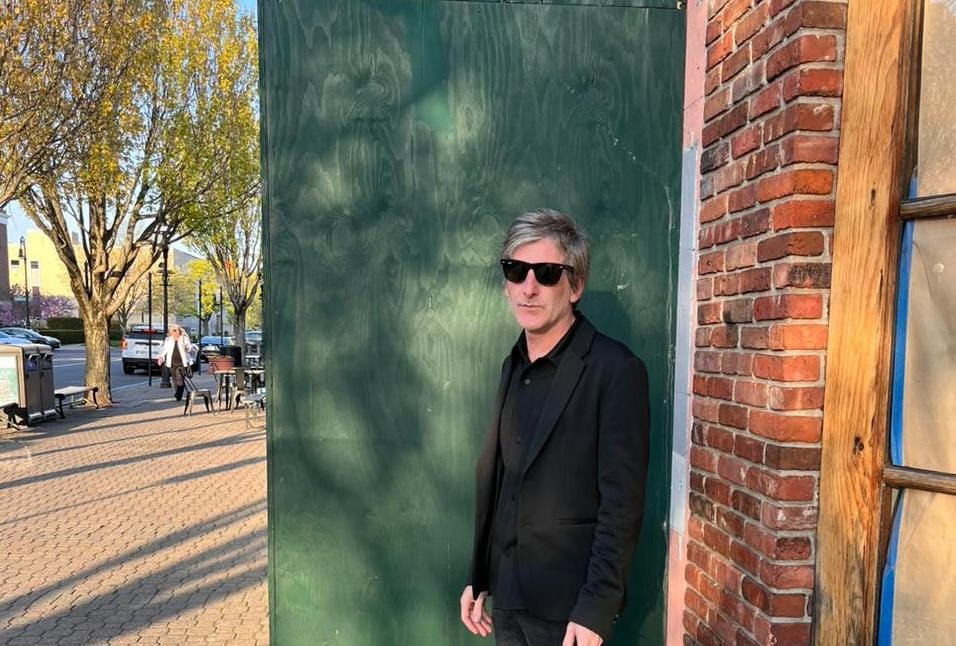
Point Lookout,  Long Beach, New York

Pulling some crap
 
Of pardine sun, I embrightened 
          down tired trails 
                     I pulled the crap
of my own face into the mud 
because when we were young
they shielded their wounds 
           and the laden flags
decimated distances 
 
Of lacrimal sun, I embrightened
          the sun to sky
                      I pulled the crap
of the crowded core 
and in the lizard’s pace
          I pondered my dark’s sum 
without the poison of acacia trees
          that endures

….

translated from the Spanish by Patricio Ferrari | Asymptote© 2024


Juan Arabia is a poet, literary translator, critic, and editor. Born in Buenos Aires, Arabia is also the founder and director of the cultural and literary project Buenos Aires Poetry. He regularly contributes as a critic for Perfil and Revista Ñ of Clarín, one of the most circulated newspapers in the Spanish-speaking world. Among his latest poetry collections, we find Desalojo de la Naturaleza (Eviction of Nature; Buenos Aires Poetry, 2018), Hacia Carcassonne (Towards Carcassonne; Pre-Textos, 2021), and Bulmenia (Buenos Aires Poetry, 2022). Arabia gained international recognition with El enemigo de los Thirties (Enemy of the Thirties; Buenos Aires Poetry, 2013), leading to his participation in poetry festivals across Latin America, Europe, and China. He has translated works by Arthur Rimbaud, Ezra Pound, T.S. Eliot, and John Fante, among others, and his poetry has been translated into English, French, Italian, and Romanian. Arabia lives in San Telmo (Buenos Aires) with his wife, designer, and translator Camila Evia, and their son Cátulo.

Patricio Ferrari is a polyglot poet, literary translator, and editor. Born in Merlo to Piemontesi and Calabresi immigrants, he left Argentina at the age of sixteen to attend high school and play soccer in the United States as part of the Rotary Exchange Program. His most recent translations include Verde amargo / Bitter Green by Martin Corless-Smith (with Graciela S. Guglielmone; Buenos Aires Poetry, 2022), The Complete Works of Álvaro de Campos by Fernando Pessoa (with Margaret Jull Costa; New Directions, 2023), and Habla terreña (Field Talk) by Frank Stanford (with Guglielmone; Pre-Textos, 2023). His work has been featured in The New YorkerThe Paris ReviewThe New York Review of Books, Southwest Review, and Fence, among others. Since 2017, he has resided in New York City, where he is currently working on “Elsehere,” an exophonic trilogy of multilingual poetry. Additionally, he teaches the Master of Fine Arts at Sarah Lawrence College, collaborates with the Endangered Language Alliance, and hosts the World Poetry in Translation reading series.


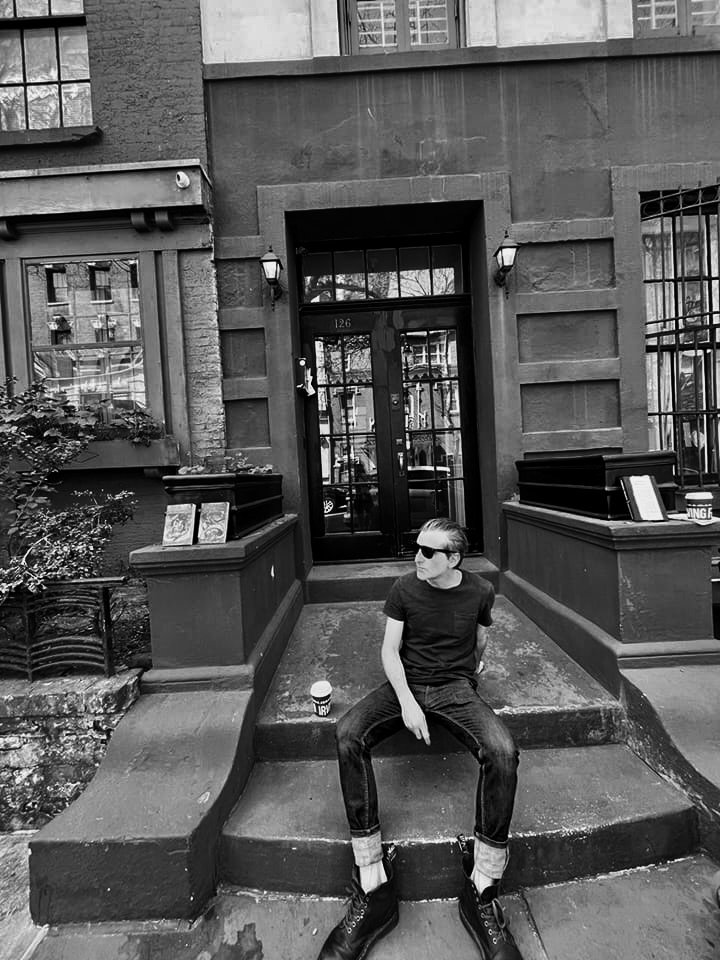
Gramercy Park, NY

Juan Arabia is a poet, translator, literary critic, editor and publisher. Born in Buenos Aires in 1983, he is founder and director of the cultural and literary project Buenos Aires Poetry. Arabia is also in-house literary critic for the Cultural Supplement of Diario Perfil and Revista Ñ of Diario Clarín. Among his most recent poetry titles are Desalojo de la Naturaleza [Eviction of Nature] (Buenos Aires Poetry, 2018), Hacia Carcassonne [Towards Carcassonne] (Pre-Textos, 2021), and Bulmenia (Buenos Aires Poetry, 2022). After the publication of El enemigo de los Thirties [Enemy of the Thirties] (2013), awarded in France, Italy, and Macedonia, Juan participated in several poetry festivals in Latin America, Europe, and China. In 2018, on behalf of Argentina, he was invited to the “Voix vives de Méditerranée en Méditerranée” poetry festival in Sète (France). The following year he became the second Latin American poet to be invited to the “Poetry Comes to Museum LXI,” sponsored by the Shanghai Minsheng Art Museum. Arabia has translated works by Ezra Pound, Arthur Rimbaud, Dylan Thomas, and Dan Fante, among others. Two of his books have been translated into French (L’Océan Avare, trad. Jean Portante, Al Manar, 2018) and Italian (Verso Carcassonne, trad. Mattia Tarantino, Raffaelli Editore, 2022). Some of his poems have been featured or are forthcoming in English translation by Patricio Ferrari in Asymptote, The Brooklyn Rail, and Fence, among others. He lives in Retiro (Buenos Aires) with his wife — the designer, poet, and literary translator Camila Evia — and son Cátulo.


Retiro

Algún rascacielos se escinde en su altura pero la visión total no es whitmaniana las líneas horizontales vencen a las verticales y las esquinas, a pesar del gris plata, todavía alimentan las antiguas orillas de su vientre, convocando inevitables suburbios que se esconden y que parecen derrotados, aunque respiran, caminan y duermen bajo tus talones

Unpublished (Nueva Poesía, 2024)


外滩

这些旋律会飞向天边更高处吗?
以面具做一个更寒酸的
伪装,拂去
他人生阅历的灰烬,
磨钝棱角,
召集他所创造的物种。

我们的工作,最黑暗的部分,
正饮此江水
                    圆明园路
愚昧的是那个
不相信洪流的人。


The Bund

Will these songs fly even higher?
From a mask they’ll make an even poorer
artifice, reducing the
ashes of their life experience,
dulling his horns,
assembling the created species.

Our work, the darkest,
drinking from the same ocean
                    圆明园路
Foolish is he who
believes not in deluges.


International Festival of Poetry & Liquor, Liquor City of China •the 7th Art & Culture Week of Luzhou Laojiao (CHINA) | October 14 – 17, 2023.

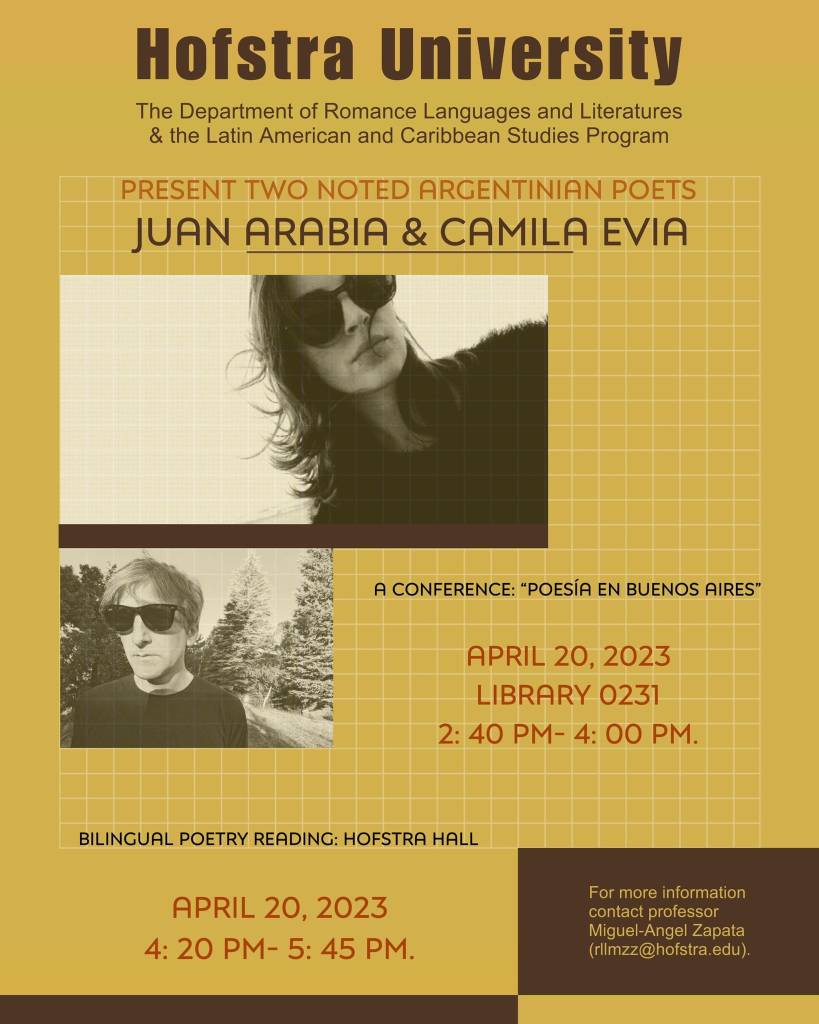
BILINGUAL POETRY READING: JUAN ARABIA & CAMILA EVIA | Hofstra University April 20, 2023, HOFSTRA HALL

spring torn page: Juan arabia & wang ying (spanish and chinese in english translation + discussion hosted by patricio ferrari | april 16, 2023 | Torn Page (435 W 22nd St, NYC)

The Brooklyn Rail: Buenos Aires and New York City, with the World in Between: A Rail Reading curated by Juan Arabia and Patricio Ferrari | Wednesday, March 8, 2023 | 1 p.m. Eastern / 10 a.m. Pacific

XV Festival internacional san luis de potosi (México) | 14 – 18 Noviembre, 2022

LitVest (Timisoara, Rumania) | 21 – 24 Septiembre, 2022

Bucharest International Poetry Festival 2022 (Rumania) | 12 – 18 SEPTIEMBRE, 2022


湖区

我,在第一条船上拒绝了基督,
终于懂得再见 * 的涵义。
它不只是一次别离:
是一切都下沉到
白色透明的数字海洋里的时刻,
花朵也失落了,这天堂存在的
唯一证物。

那一刻空气中迫近的热度
也失落了,这热度禁闭又拆散
世界上存在的每一件事物。


* 西班牙语中的“再见”(adiós)字面意思为去见上帝, 或上帝与你同在。


Lake District

I, who denied Christ on the first ship,
finally understood the meaning of the word farewell.
It is not a simple goodbye:
it is in the moment in which everything drowns
in the white and transparent seas of numbers,
and the flower is lost, the only proof
of the existence of a paradise.

It is in the moment in which the immediate heat 
of the air that imprisons and separates
each and everything that exists in the world
is lost.


Translated by James Byrne.


Distrito de los Lagos

Yo, que negué a Cristo en el primer barco,
finalmente entendí el significado de la palabra adiós.
No se trata de una simple despedida:
es el momento en el que todo se hunde
en los blancos y transparentes mares de números,
y se pierde la flor, única prueba de
de la existencia de un paraíso.

Es el momento donde se pierde el inmediato calor
de aire que encierra y separa a cada una
de las cosas que existen en el mundo.


le poète sud-américain

le poète sud-américain exige un contexte
fleurs amères qui contrastent avec le jardin
et simulent tout au plus les voix disparues
mais le long terme est deux fois plus sombre
un déluge en contient maintenant un autre
comme une nouvelle tumeur après métastase
visible seulement par quelques-uns —


Juan Arabia, Nueva Poesía, 2024

Juan Arabia is a poet, translator, literary critic, editor and publisher. Born in Buenos Aires in 1983, he is founder and director of the cultural and literary project Buenos Aires Poetry. Arabia is also in-house literary critic for the Cultural Supplement of Diario Perfil and Revista Ñ of Diario Clarín. Among his most recent poetry titles are Desalojo de la Naturaleza [Eviction of Nature] (Buenos Aires Poetry, 2018), Hacia Carcassonne [Towards Carcassonne] (Pre-Textos, 2021), and Bulmenia (Buenos Aires Poetry, 2022). After the publication of El enemigo de los Thirties [Enemy of the Thirties] (2013), awarded in France, Italy, and Macedonia, Juan participated in several poetry festivals in Latin America, Europe, and China. In 2018, on behalf of Argentina, he was invited to the “Voix vives de Méditerranée en Méditerranée” poetry festival in Sète (France). The following year he became the second Latin American poet to be invited to the “Poetry Comes to Museum LXI,” sponsored by the Shanghai Minsheng Art Museum. Arabia has translated works by Ezra Pound, Arthur Rimbaud, Dylan Thomas, and Dan Fante, among others. Two of his books have been translated into French (L’Océan Avare, trad. Jean Portante, Al Manar, 2018) and Italian (Verso Carcassonne, trad. Mattia Tarantino, Raffaelli Editore, 2022). Some of his poems have been featured or are forthcoming in English translation by Patricio Ferrari in Asymptote, The Brooklyn Rail, and Fence, among others. He lives in Retiro (Buenos Aires) with his wife — the designer, poet, and literary translator Camila Evia — and son Cátulo. 

CRUZ

Vista mi cruz, porque descendí de occidente,
aunque de sus bordes brotan otras cruces
…………….mis animales muertos
y la prematura oscuridad del hijo no bautizado

Cruz, tanta basura acumulada,
tantos brotes mal sepultados
que deberías ser uva natural, para crecer
sin dar órdenes o mensajes estériles

Asfixia de madera bañada en oro para los tontos,
cruz, deja a mi cuerpo acumular su barro
y dar su forma, y que sea solo del cielo
el norte que nos separa de la tierra


Juan Arabia | Punta del Este, Uruguay, 2024

VIGILANTE NOCTURNO

De qué otra manera puedes explicar
todos estos céspedes sin mantas
perfectas formaciones de roca
hogares sin lámparas
muertas oberturas de los vórtices

deja algo de luz para los autobuses
donde juegan los niños perturbados
aquí solo se fortalece la sombra de luz negra
probablemente estemos en el infierno
y necesitemos beber un trago

pero no hay puertas
solo una pared y el vigilante nocturno
que pasa todo su día encerrado
para juntar algo de soles
y pagar en cruz de bronce su entierro